At a glance
The story at a glance
- A mouse can favor extra controls or a lighter, pared-back feel.
- Keyboard size changes the geography of a gaming desk.
- Headsets make space for both game sound and conversation.
- Force feedback brings a racing game into the hands.
- A handheld moves play away from the desk.
A desk built around play
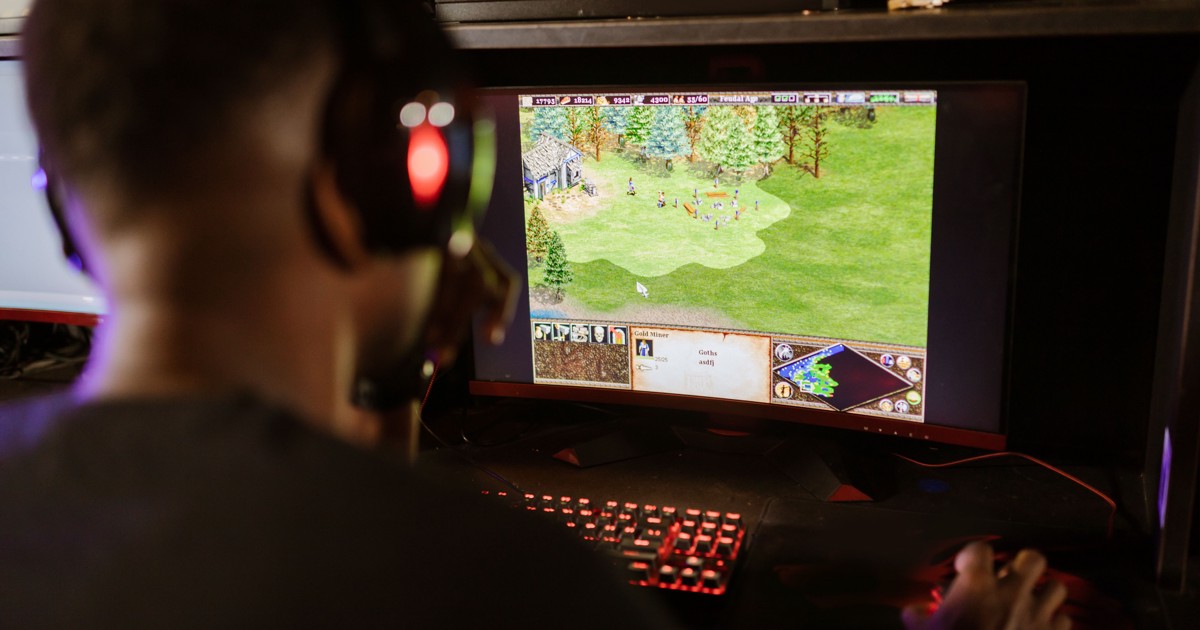
The first thing you notice about a gaming setup is often the light: a wash of blue across a keyboard, a monitor reflected in a dark desk, a mouse glowing beside an abandoned glass of water. Stay a little longer and the more interesting details come into focus. The mouse has a shape that invites the hand to settle in one particular way. The keyboard leaves just enough room for a sweeping movement. A headset hangs within reach, ready to turn a noisy room into a place of concentration.
Logitech G makes the objects at the center of that scene. Its world includes gaming mice and keyboards, headsets, racing wheels, and handheld devices: equipment designed around the physical habits of play. Some pieces look restrained enough for a shared workspace; others lean into color, lighting, and the unmistakable visual language of gaming.
What connects them is an interest in the small exchanges between a person and a game. A finger presses a key. A wheel resists a turn. A voice comes through a headset while the rest of the household carries on. These are modest moments, but they happen again and again, and their accumulated feel becomes part of the experience.
Logitech G and the feel of control
A game can ask for many kinds of attention. A competitive shooter rewards quick decisions and precise movement. A long role-playing game gives the hands hours of smaller tasks: opening maps, sorting inventory, choosing dialogue. A racing game asks the body to read a corner as much as the screen does.
Logitech G’s range reflects those different rhythms rather than treating every player as if they sat the same way and played the same thing. A streamlined mouse has a different purpose from one with a cluster of programmable buttons. A compact keyboard changes the geography of a desk compared with a full-size board. A racing wheel introduces a physical gesture that a keyboard cannot quite imitate.
The brand also uses its own names for some of the technologies running through the range. LIGHTSPEED refers to its wireless technology; LIGHTSYNC is associated with compatible lighting features. On the mouse side, HERO is the name used for Logitech G’s optical sensor family. Those names matter less as slogans than as clues to the design priorities: responsive input, cable-free movement on certain devices, and lighting that can become part of a setup’s character.
The gear is most interesting where it changes how a game feels in the hand.
That might be the space saved by a smaller keyboard, or the satisfying familiarity of a mouse whose buttons have become second nature. The distinction is physical before it is decorative.
The many personalities of a mouse
The gaming mouse is a surprisingly expressive object. It is held for long stretches, moved in tiny corrections and broad sweeps, and asked to make repeated actions feel natural. Logitech G’s mice show just how many interpretations that one object can support.
The G502 family has a substantial, sculpted look, with a thumb rest and multiple programmable controls that give the hand a defined place to land. It suggests a player who likes having commands close at hand: not just movement and clicking, but useful actions assigned to buttons beneath the fingers and thumb. The scroll wheel is another part of its identity, a detail that matters when a mouse moves between games and ordinary browsing.
The PRO X SUPERLIGHT line takes a different visual and physical approach. Its clean silhouette and emphasis on low weight speak to players who prefer a mouse that feels less prominent during fast movement. There is less visual complexity to negotiate; the form is pared back around the essentials.
Neither personality is inherently more authentic. One is about having more controls within reach; the other favors a lighter, simpler presence. That contrast is useful for understanding Logitech G as a whole. The brand is not trying to make every desk look or feel identical. It is making room for different hand movements, different games, and different ideas of what control should feel like.
Keyboards as desk architecture
A keyboard shapes a setup before a game even begins. Its width determines how much room remains for the mouse. Its height changes the angle of the hands. Its sound becomes part of the room: a sharp sequence of taps, a softer rhythm, a burst of movement during a tense moment.
Logitech G’s keyboard range spans familiar full-size layouts and more compact designs. A full-size board gives the number pad a permanent home, which can be useful when a desk serves work and play in equal measure. A tenkeyless layout removes that section, creating more space on the right for mouse movement. The difference is easy to picture on a crowded desk: a few inches can change where the shoulder rests and how freely the arm moves.
The G915 family is known for a low-profile mechanical design, pairing a slim appearance with the distinct feel of mechanical keys. Other Logitech G boards have a more traditional profile, with key switches and layouts that vary by model. Lighting, too, can be understated or conspicuous, depending on the keyboard and the way its owner chooses to use it.
There is something pleasingly architectural about this category. A keyboard is a flat rectangle, but its edges, key height, and spacing organize the objects and movements around it. Logitech G treats that rectangle as more than a row of commands; it is the anchor of the whole desktop scene.
Headsets and the space between voices
Sound gives games their sense of distance. Footsteps may approach from somewhere offscreen; a soundtrack can make an otherwise empty landscape feel enormous. Just as important, a headset carries the ordinary social texture of play: a friend calling out a direction, a plan revised halfway through a match, the brief silence when everyone is concentrating.
Logitech G’s headsets cover several moods. The PRO X line has a relatively restrained look, with padded earcups and a microphone positioned for conversation. The G733 is more playful in appearance, with a suspension-style headband and lighting that makes the headset part of the room’s visual composition as well as its soundscape.
The practical details are tactile. Earcup padding sits against the head; a headband distributes the feel of the headset across the top; a microphone puts a voice into the shared space of a game. Some models are wireless, which changes the little movements around a desk: standing up, reaching for something, or shifting position without a cable crossing the chair.
A headset is also a boundary. It lets a player inhabit a game’s atmosphere while the rest of the room remains someone else’s space. Logitech G’s designs make that boundary look different depending on the model: subdued and almost studio-like in one case, bright and openly playful in another.
When the screen becomes a road
A racing wheel changes the relationship between a game and the body. Instead of nudging a direction with a thumb or tapping a key, the player turns through a corner, eases the wheel back, and works the pedals. The screen is still a screen, but the motions have a recognizable connection to driving.
Logitech G’s racing range includes the G923, a wheel-and-pedal setup that uses force feedback to communicate aspects of the simulated drive through the steering wheel. Its TRUEFORCE technology is designed to work with supported games, adding another layer of feedback linked to the game’s physics and audio. The effect is not the same in every title, but the ambition is clear: to make the road register through the hands as well as the eyes.
The objects themselves bring a different kind of presence to a room. A wheel has a rim to grip, spokes, controls, and the unmistakable posture of a driving position. Pedals sit below, turning the floor into part of the game. This is a more committed arrangement than a mouse beside a laptop, but it also makes a familiar corner of a home feel briefly like a cockpit.
Racing gear shows the range of Logitech G particularly well. The same brand that makes a compact desktop mouse also makes equipment built around whole-arm movement and the feel of resistance. Both begin with the same question: what should a virtual action feel like in the real world?
Gaming beyond the desk
Not every session needs a chair, a monitor, and a carefully arranged keyboard. Logitech G’s G CLOUD handheld points toward a different scene: a player holding the screen and controls together, perhaps settling into a couch or moving to another room.
The device is designed around cloud gaming and has a built-in screen with physical controls on either side. Its shape follows the familiar logic of a controller: the hands wrap around the ends while the thumbs find sticks and buttons. What changes is the setting. The screen is no longer across a desk; it is part of the object in the player’s hands.
Cloud gaming depends on a network connection and compatible services, so the experience is tied to more than the handheld itself. Still, the appeal of the form is easy to understand. A large game can occupy a small patch of space, and the rituals around play can become more relaxed. There is no wheel to mount or keyboard to clear a place for.
Alongside Logitech G’s desktop equipment, the handheld broadens the picture of who gaming gear is for. It can serve the person who likes a dedicated setup, but also the person who wants play to fit among the other activities already happening at home. The brand’s product world stretches from an elaborate driving position to a device held in two hands.
A setup with room for personality
Gaming equipment has never been purely invisible. Even the most practical mouse sits on display, and a headset left on a desk becomes part of the room. Logitech G’s designs acknowledge that fact in different ways, moving between dark, performance-oriented finishes and more colorful pieces that invite a setup to show some personality.
Lighting is one of the clearest examples. On compatible products, RGB illumination can turn a keyboard or headset into a small source of color. It might echo the glow of a monitor, pick up another accent in the room, or simply make the keys easier to notice in a dim setting. For some people, that visual layer is central to the pleasure of a setup. For others, it can be kept quiet.
The brand’s visual variety also reflects a wider change in where games live. A gaming desk might be in a bedroom, a living room, or a corner that doubles as a home office. It may need to accommodate a workday as readily as an evening match. A low-profile keyboard or a restrained headset can sit comfortably in that mixed-use environment; a brightly lit setup can make the same corner feel distinctly its own.
There is no single Logitech G look that covers every product. The common thread is a willingness to let equipment participate in the atmosphere around play, whether that means a near-invisible black mouse or a headset that contributes its own color to the scene.
The details that stay with the player
The most memorable part of a gaming setup is not necessarily the thing a visitor notices first. It may be the way a thumb finds a familiar button without looking, the sound of a key returning after a press, or the pressure of a wheel pushing back through a turn. These details become legible through repetition.
Logitech G’s product families give those repeated gestures different forms. The G502 makes room for extra controls; the PRO X SUPERLIGHT pares the mouse back; the G915 gives a mechanical keyboard a slimmer profile. A G733 headset adds color and a suspended headband, while a G923 wheel brings the hands and feet into the action. Each is a different answer to a different kind of play.
That variety is more compelling than the idea of one perfect setup. Some players want the desk to disappear into the task. Others want it to look like a place where something enjoyable happens. Some will spend an evening talking with friends through a headset; others will return to the same corner of a racing circuit, feeling for the right moment to turn.
In each case, the screen supplies the world. The equipment supplies the points of contact. And those small points of contact—the weight beneath a hand, the space around a keyboard, the voice arriving in an ear—are where Logitech G’s approach becomes tangible.
A few questions, answered
6 answersWhat kinds of gaming equipment does Logitech G make?
Logitech G makes gaming mice, keyboards, headsets, racing wheels, and other devices, including a handheld designed for cloud gaming.
How do the G502 and PRO X SUPERLIGHT mice differ?
The G502 family has a sculpted shape and multiple programmable controls. The PRO X SUPERLIGHT line takes a lighter, more pared-back approach, with an emphasis on easy movement.
What distinguishes the Logitech G G915 keyboard?
The G915 family is known for its low-profile mechanical design, giving the keyboard a slimmer appearance than many traditional mechanical boards.
What is Logitech G LIGHTSPEED?
LIGHTSPEED is Logitech G’s wireless technology. It appears in a range of compatible gaming devices, including certain mice, keyboards, and headsets.
What does the G923 racing wheel add to a game?
The G923 uses force feedback to communicate aspects of a simulated drive through the wheel. Its TRUEFORCE technology is designed to add feedback linked to game physics and audio in supported titles.
What is the Logitech G CLOUD handheld designed for?
G CLOUD is a handheld with a built-in screen and physical controls, designed around cloud gaming. Cloud play depends on a network connection and compatible services.